Short answer: The painter works against an ungraded plate, months before the colourist begins, and the result must still hold up after a grade that no one has applied yet. The only way to keep that stable is to work inside the show's colour pipeline rather than try to match a look by eye on a monitor. A painting matched by eye to a viewing copy looks correct only once and shifts as soon as anything downstream changes.
A lack of skill is seldom the reason for this, the most common avoidable redo in environment work. The cause is the setup, and within the first ten minutes of a package, the outcome usually depends on whether the transform was sent out with the plate.
For the studio-side person who hands a package to a vendor, or receives one from them.
The problem, stated plainly
A plate differs from a picture. It records light in a wide range format, and when displayed directly it looks flat and grey because it holds far more information than a monitor can show at once.
You examine it by applying a transform that maps that recording onto a display. The result you see is an interpretation, and the same plate supports many possible interpretations.
A painting made to match what you see is matched to the way you read it. Change that reading, which is exactly what a colourist does for a living, and the match disappears. All the rest of this article rests on that one fact.
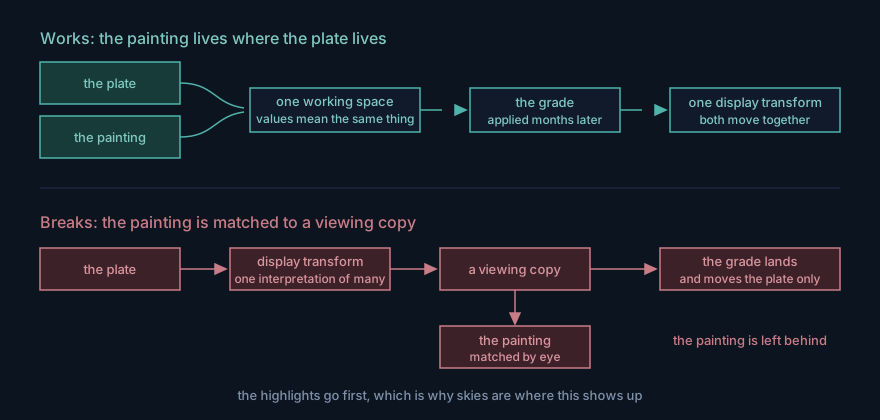
What working in the pipeline actually means
Three items cost little to prepare ahead of time and a lot to prepare afterward.
Both the plate and the painting exist in the same working space. No conversion happens at the end. Because it is made there, every value in it carries the same meaning as its counterpart in the photography. When a show has standardised on the Academy Color Encoding System, published through ACESCentral at acescentral.com, the space has already been chosen, and the vendor only needs to be given its name.
Viewing uses the same display transform as the show itself. Both the plate and the painting pass through one shared interpretation on their way to the monitor. Then the artist compares like with like, and the eye sees what is true. Colour management systems made for motion picture production, OpenColorIO at opencolorio.org among them, let a show name that viewing setup in one line instead of describing it.
It is delivered in that space, and the format keeps it. It is a wide-range image format, not a display-referred file. For environment work, that usually means OpenEXR, a format maintained by the Academy Software Foundation at openexr.com and one that carries scene-linear values and several layers in a single file. If a delivery has been baked into a display interpretation, the bake cannot be undone, and the show has lost the headroom it requires.
The plate and the painting are the same kind of thing from the pipeline's perspective, so a grade applied later moves them together when those three hold. That is the entire objective.
Why "it looks right on my monitor" is not the test
If an artist has a monitor and enough time, they can match anything by eye. The match genuinely exists, but only for that one interpretation, on that one display, and at that one moment.
The differences emerge when you send the same pair through another display transform. The painted version uses values chosen to look correct after an interpretation, not values that describe light. The first place this usually becomes visible is in the highlights. Photographic highlights retain information far above what the monitor can show, while a painted highlight matched to the monitor often does not. As soon as a colourist lifts any area, the plate has detail in that bright region and the painting has a flat patch.
Because skies are painted more than any other subject, the problem is most visible there, and that is why it has gained a reputation.
Practical consequences at the package boundary
When you send the plate, include the transform. Send the working space, display transform, and any show LUT. This takes one line in an email and removes the most common cause of redoing a delivery.
Ask for the delivery in the working space. It should be layered, have a wide range, and stay unflattened. If a vendor cannot do this, that tells you something useful about their pipeline.
Never submit a viewing copy as the reference for the match. When you have to send one for review, mark it as review only, because an artist will match the reference file, and from the outside they cannot tell which of your files is authoritative.
Assume the plate will change and plan accordingly. The plate will probably change at least once. Work built so the plate can be replaced survives that change. Work built with the plate embedded in it does not, and the distinction is a method decision made at the start.
What about the grade the show has not made yet?
No grade exists for you to match. You can make the painting behave the way a photograph does, so that anything the colourist does later has the same effect on it as on the plate.
That is the true purpose, and the brief should state it in those words. The vendor's task is not to anticipate the final appearance. It is to supply something that behaves correctly once the final appearance is added. A painting that already has a look, regardless of its quality, is one that the colourist has to work around.
This instruction has a short practical form. Work inside the show's space, look through the show's transform, provide wide range and layered, and leave the look untouched.
Does this apply to a single shot as well?
Yes, and the reason deserves mention, because the urge to skip setup is strongest on a single attempt.
A single shot still receives grading. It still appears in an edit beside shots that have already been graded. A vendor relationship often begins with a single shot, so the shortcut used on the pilot becomes the method for the package that follows.
The one-time setup of the colour path, done correctly, takes little time and determines whether a note that says "warm the sky slightly" becomes a ten minute change or a return trip through the whole shot.
Where to go from here
Based in Toronto, Chumak Studio creates environments for film and television and routinely operates within the show's colour pipeline. Its environment services are digital matte painting and 3D environments.
When you are building a package, include the plate together with the working space and the display transform. That is enough to begin a genuine discussion about the shot itself instead of a discussion about files.