Short answer: Replacing a sky alters the lighting across the shot, not just the top of the frame. It determines the reflections, wet surfaces, rim light on faces, hair edges and the grade. If you do that before the edit and the grade are final, you make the choice without the information that has not arrived yet, and you usually have to redo it later at full price.
People often think of sky replacement as a quick solution, and for a single frame with an uncluttered horizon it truly can be. It becomes problematic when the edit is handled as a minor localized adjustment rather than a choice about light, and when it is made early just because it appears to be the easiest task on the list.
The job actually entails this, and the cost is in the timing, not in the painting.
What a sky replacement actually involves
Only the first of the three pieces of work is the sky.
Cutting the old sky away from everything that sits in front of it. This is simple against a hard building edge. Trees, hair, smoke, rain, fences, chain link and any partly transparent material make the task difficult. This one step is most of the work on a difficult shot, and the lens, the exposure, and whatever happened to be in front of the horizon set how hard it is on the shoot day.
Replacing the sky with a new one that fits the plate. The replacement must match the lens, the grain, the depth of field, and the actual direction and quality of the on-set light. If a sky is beautiful but lit from the wrong side, the shot will be worse than the original.
Aligning everything else to match it. The part people do not budget for, and what the next section is about.
The sky is never only the sky
When you change the sky, the largest light source in the frame changes.
When the new sky is heavier than the old one, the ground appears too bright and the shadows too hard for the weather being claimed. A clearer replacement produces the opposite result. Any wet surface, window, car, puddle, or polished floor shows a reflection of a sky that is no longer there. The original sky produced the rim light on the actors, and that light now points at the wrong object. Distant haze in the plate carries the old sky's colour throughout the whole background.
Each of these problems is fixable. Every one of them is work, and that work is not something a bid for "replace the sky" usually includes. The useful internal description for the job is not sky replacement. It is relighting the exterior, and the sky is the visible part of that exterior.
Why doing it early costs more
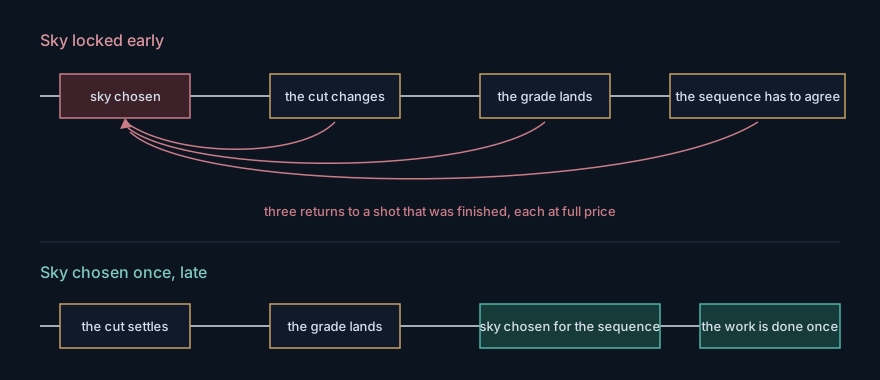
To choose a sky early is to choose it without the three things that are still coming.
The cut. Shots lengthen or shorten, change order, and drop out. A sky selected for a sequence in one order can look like a continuity error in another, since viewers track time of day across a scene even when no one meant them to.
The grade. The colourist has not touched it yet. A sky matched to the ungraded plate can clash with the final look, and the fix at that point is sending the shot back through visual effects, not turning a knob on the grading panel.
The other shots. Rarely is a sky one shot. It consists of a sequence, and that sequence has to remain coherent. The shot handled first is the one most likely to be redone, because whatever is learned from shots two through eleven arrives only after that first shot is finished.
All three show the same pattern. The initial choice is cheap to make and expensive to undo; because the shot cannot receive final approval until the cut and the grade have settled, deciding early means deciding with less information and no schedule gain anyway.
The cheap version and the expensive version
| Cheap | Expensive | |
|---|---|---|
| Horizon | Hard edges, buildings, clean hills | Trees, hair, chain link, smoke, rain |
| Camera | Locked or a small move | A large move, or a tilt that reveals more sky |
| Surfaces in shot | Dry, matte | Wet ground, glass, water, vehicles |
| Actors | Mid or wide, sky not on their faces | Backlit close-ups with rim light from the sky |
| Sequence | One shot | Twelve shots that must agree with each other |
| Timing | After the cut and grade settle | Before either has settled |
A shot can fill five rows in the left column and only one in the right, and that single row sets the price. Backlit hair against a bright sky is the standard case. It looks like a normal shot, but it is not.
What can I do on the shoot day to make this cheaper?
Quite a lot, and none of it slows the day down much.
When you can, take a clean plate of the same framing with no actors in the shot. Take pictures of the real sky and light as a reference, and include one exposure that keeps detail in the bright area, so that anyone can match the lighting you had instead of guessing. Record the time and the direction the camera was pointing.
If you already know the sky will be blown out, avoid a composition that puts a hard edge against it. Shift the camera just a little so a character's backlit hair falls against a building instead of the sky; this turns a difficult shot into an easy one, and it costs nothing on the day.
And state it aloud on set. When everyone on set knows a shot will get a new sky, people who have done this before photograph it differently in small ways that accumulate.
The one rule worth keeping
Set the sky a single time, late, for the full sequence, and treat that choice as a lighting decision, not a fix.
The rest of this article is based on that point. If you genuinely have to begin early because of the schedule, start with the hardest shot instead of the easiest one. You learn what approach you need from the hard shot, and you learn nothing from getting the easy shot wrong until it is too late.
Where to go from here
In Toronto, Chumak Studio creates painted environments for film and television, with sky work included in digital matte painting.
When you have a sequence that needs sky replacements, send the shot list and note which shots contain wet ground, backlit faces, or trees on the horizon. Those shots determine the number, and you will get a straight answer about which of them are simple and which are not.