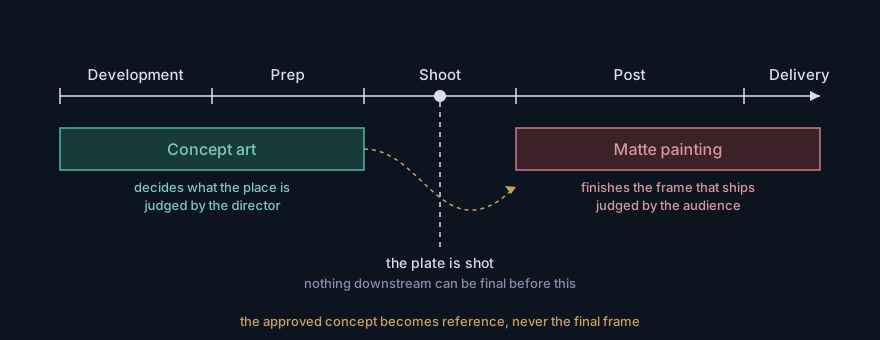
Short answer: Concept art is a picture used for decisions. Its job is to end a dispute over how a location should look before any construction or filming takes place. A matte painting is the finished image that is cut against photography and placed in the film at delivery resolution. When a picture will be seen by an audience, use a matte painting. When it will be seen by a director, use concept art.
Each of the two jobs creates an appealing picture of a place that is not real. The entire confusion stems from that fact, and it is costly, because the two pictures are produced at the start and end of the schedule by people whose skills differ, and neither one can be changed into the other.
Use this to identify which option your shot truly needs, how much time each option costs you, and what results when a production orders the wrong option.
What concept art is for
Concept art is made to get a decision out of a room.
A fortress cannot be designed, budgeted, scouted, built, or costed as a visual effect until someone settles on its look. The concept artist creates the image that ends the discussion. That image has to be convincing and clear at a glance, and it has to be produced quickly enough that four versions can exist by Thursday.
It does not need to be accurate. A city concept painting may show a skyline that would not hold up under measurement. Since no floor plan exists yet, the windows do not have to match one. The picture makes an argument rather than serving as a specification.
Concept art is therefore usually supplied at whatever size looks good in a review, in a format no one plans to composite. It is a document. It goes in a deck, on a wall, into a pitch, and into a design bible. After the decision it was created to support has been made, its job is done.
Visual development is adjacent to this. A single concept painting answers one question; visual development establishes the whole set of rules for a world, meaning its materials, light, architecture, and color palette, so that every later drawing stays consistent with all the others.
What a matte painting is for
For the film, a matte painting is created.
It appears only after the plate is shot. Using the frame the camera actually captured, with that lens, grain, light, lens flare, and focus falloff, it fills in the part of the frame the production could not photograph. It then has to withstand being cut next to a shot that is entirely photographic.
Any looseness allowed in concept art becomes a firm requirement here. You work at the delivery resolution. The colour must sit within the show's pipeline, so the colourist does not have to fight it. Perspective has to follow the actual lens instead of simply appearing right. When the camera moves, the painting must be split by depth so the parallax works, which adds another level of effort.
What viewers see is never a matte painting. They are looking at a place. That is the test, and it is stricter than any test a concept image ever has to pass.
The differences that decide the money
| Concept art | Matte painting | |
|---|---|---|
| When it happens | Development and prep | Post, after the plate exists |
| What it answers | What should this place be | Is this frame finished |
| Input it needs | A script, a mood, a conversation | The plate, the lens, the cut, the grade |
| Judged by | The director and the department heads | The audience, and the shot next to it |
| Resolution | Whatever reviews well | Whatever the film delivers at |
| Revision driver | Taste, and the story | The plate, and the edit |
| What it costs to redo | An afternoon | The shot |
The third row is the one that counts most. Starting concept art takes almost nothing. A matte painting cannot begin correctly before a plate exists, and if it starts earlier, it starts as a guess that will need correction against the actual frame later, which means doing the same work twice.
What goes wrong when a production orders the wrong one
Two failures, and they fail in different directions.
Requesting concept art when the shot required a matte painting. The production receives an eye-catching image, everyone signs off, and once it reaches the compositor it will not sit in the plate. The perspective is close, but the lens does not match. The horizon is tilted by a few degrees. There is no depth data to split it into layers. The value range was painted for a meeting-room screen, not for the show's colour pipeline.
None of that is the artwork's fault. The image was never intended for that role. The shot then gets remade properly, and the schedule loses whatever the first attempt used up.
Ordering a matte painting before the design is settled. This one is less visible and generally costs more. After a frame is built to delivery standard, the director may change the building, the time of day, or the direction the character is looking. These changes are cheap in a concept sketch and severe in a finished painting, because the finished painting is a structure of layers, projections, and grade that all took the old answer as given.
The giveaway is simple. When anyone in the room still disputes how the place looks, the production is in concept art. When everyone agrees and the only remaining question is whether the frame is convincing, the production is in matte painting.
What if the shot needs both?
For most environment shots of any size, that is the case, and it involves no conflict. They are simply separate purchases.
Usually, design comes before the build. While changes are still possible, Concept art defines what the place is. That approved image then serves as reference for the matte painting, which is produced against the plate months later. Sometimes the same artist performs both stages, which helps because the intent remains intact across the gap. The concept image is never passed to a compositor as though it were the final frame.
Request them as two deliverables with two approval points when you order both, not as one job that quietly shifts into a different kind of work partway through. The schedule holds with that arrangement.
How do I tell which one I am asking for?
Answer these three, and it resolves itself.
Has the shot been filmed? You are in concept art when no plate exists and the decision about the frame contents is not locked. You are in matte painting when a plate exists and the edit is still settling.
Who is the audience for this image? When the director, the studio, a department head or an investor is the audience, the image is concept art. When the person watching the film is the audience, the image is a matte painting.
What occurs if it is wrong? The result is concept art when wrong means someone requests another version. The result is a matte painting when wrong means the shot fails.
As you brief it, state the answers aloud. A matte painting quote and a concept art quote cover different amounts of work, and the gap between the two numbers is not padding.
Where to go from here
Chumak Studio handles environment painting for film and television in Toronto, and it also takes on the earlier design work, so the same eye can carry a place from the initial sketch to the final delivered frame. Its credit list appears at /credits/.
If you are unsure which of these a shot requires, send the frame or the script page and you will receive a direct answer, including the answer that it requires neither.