Short answer: A matte painting means an image placed into the space. A CG environment means a place you construct and then photograph. The painting takes less time, costs less, and looks better for each hour spent. The build is the only choice if the camera travels far, if the environment has to be relit, or if anything inside it has to move or be changed after it is built. The deciding factor is not size or realism. It is how much has to change after the first version exists.
Both commonly appear in the same shot, and that shared presence partly explains why the distinction gets blurred. The difference still matters, because the cost curves of the two approaches run in opposite directions and any sequence placed under the wrong approach fails suddenly instead of gradually. The failure happens once the first big note arrives.
This is written for someone choosing between them on a real sequence.
What each one actually is
The first element of a matte painting is an image. Painted material, photographic material, or both are arranged into a frame and projected onto simple geometry so the image stays steady as the camera moves. The geometry functions as a support, not as the subject. It only has to occupy the right position, and it is never visible.
A CG environment begins with the location. You build the geometry from real surfaces, assign materials that react to light, place it in a lighting setup, and render it, meaning a virtual camera takes the photograph. What results is an image, but it is an output, not the object that was constructed.
The practical difference is where the detail is kept. In a painting, the image contains the detail, so making it is quick and the result is fixed once made. In a build, the model and the materials contain the detail, so making it is slow, but afterwards you can look at it from anywhere for free.
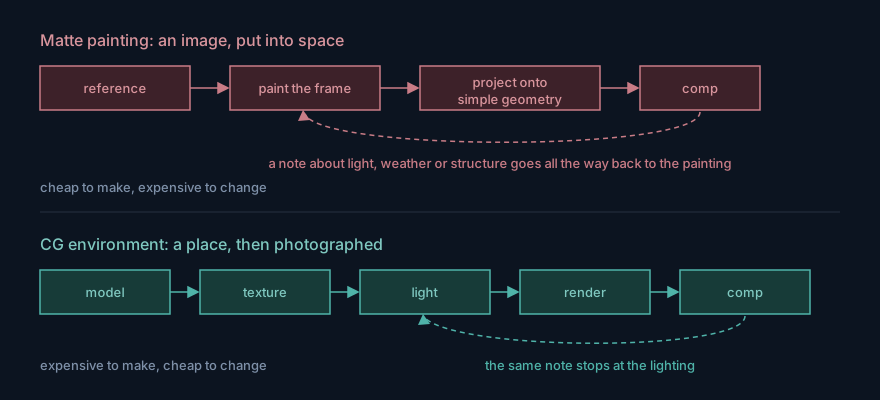
The cost curves run in opposite directions
Starting a painting costs little; changing it later is expensive. All its elements were settled when the image was made, so a note that calls for a different light, weather, time of day, or structure sends you back into the image.
A build is costly at first and inexpensive to alter. Once the space exists and is illuminated, a different angle means a different camera, a different time of day means a lighting change, and a note about the far tower means a note about one model.
The entire decision can be expressed as a question about your sequence. Will the viewing of this environment happen from one direction, once, with the design settled? If so, paint it. Will this environment be viewed from twelve directions across a season, in two weathers, while the design is still being discussed? If so, build it.
What forces a build
A camera that moves a great distance. Projection is accurate only near the point it was projected from. Move far enough past a projected surface and it no longer convinces, no matter how good the painting is.
Relighting. When the hour of day must be altered, or a large practical light in the scene must influence the environment, the environment needs to react to light. A painting cannot do that. Its light is already built in.
Anything in motion inside it. Water, foliage stirring in the wind, traffic, a structure falling down, a door that someone opens. Movement within the environment is a problem for the build.
Interaction. CG elements casting shadows onto the environment, their reflections appearing in its surfaces, characters occluded correctly by it at multiple depths.
Volume across a show. When a season includes forty shots of the same location, the initial build cost is recovered, because shots two through forty are cheap.
What forces a painting
Speed, and a settled design. A painting is complete before a build has been modelled once the design is approved and the shot count is small.
Photographic complexity. A photograph supplies weathered surfaces, tangled vegetation, true atmosphere, and the visual noise of an actual city without effort. A build must earn each of these qualities through work.
A frame nobody will walk through. On almost every production, backgrounds past a certain distance are painted, even when the foreground contains large CG environments. No benefit comes from modelling a mountain range the camera will never approach.
Most real shots use both
Normally, anything close to the camera, anything that must react and anything the camera passes through get a physical build, while painted material covers everything beyond it. The boundary between the two shifts from shot to shot and moves within a sequence.
You need to state this explicitly at bid time, because this is where scope disputes arise. A shot described as a matte painting that later requires a modelled foreground has not been under-quoted by a small amount. It has moved from one pipeline to another.
Continuity is the other place where it matters. A location that appears as a build in some shots and a painting in others must stay consistent across the cut. That calls for one person or one small group to decide the light and the palette for the whole location, no matter which technique is used for each individual shot.
Which one should I ask for?
Answer these three about the sequence, not about any single shot.
In the worst shot, what distance does the camera travel? Not the average. The worst one, because that shot determines the method for the location when continuity matters.
Will the light change? Over the course of the sequence, over the course of the season, or as a consequence of anything that happens in the story. If it does, the environment has to support being relit.
How settled is the design? When a design is still being debated, a build is preferable, because a build can take in changes and a painted finish pushes back against them. This point is the one most often missed, and it is about scheduling, not appearance.
Should the answers be short travel, fixed light and settled design, request digital matte painting and plan for quick delivery. Should any answer indicate otherwise, plan for 3D environment work beneath it, and set the sequence price accordingly.
Where to go from here
Chumak Studio, based in Toronto, makes painted environments for film and television, and also produces the 3D work that supports those environments.
When you need to determine which side of this line a sequence falls on, provide the shot list with camera moves noted. That one column gives you the answer faster than the reference does.